Encouraging manageable lifestyle changes for health and happiness, through research and personal experience.
Showing posts with label Pregnancy. Show all posts

Tuesday, June 29, 2010

Hard CORE Pregnancy

Having many friends that are currently pregnant, as well as receiving a few personal questions, has lead to this post focusing on core exercises during pregnancy. Certainly, these exercises can be done by all individuals, and can be modified in order to make them more gentle or more challenging depending on your needs.

First up: Cat and Cow stretch
Make sure your knees are directly under your hips and wrists under shoulders.
Exhale as you drop your hips and chin, lifting up through your mid back (cat stretch) and inhale as you lift your head and hips, allowing your mid back to drop through (cow).

Next: Spinal Balance
Still kneeling, wrists and knees in line with shoulders and knees (respectively), shift your hips to create a flat back (no arch, no curl). Make sure to keep your belly button pulled into your spine as you go through the following motions.
Start by lifting one arm at a time, hold and balance.

You can also do one leg at a time (make sure both hips stay facing the ground - no need to lift the foot any higher than hip height).
When you are ready to add the two together, lift opposite arm, opposite leg. Try to minimize the arch through the lower back, keeping your body as straight as possible. Variation: Fire Hydrant
For lack of a better name, in this pose you'll be on all fours, lifting one leg out to the side. Continue to keep the stomach pulled in, no arch in the lower back, focus on balance and toning the outer thigh. You can continue lifting up and down, or hold at the top and pulse.

The stability ball is a great tool for strengthening the core, and hopefully reducing tension in the lower back.
Ball sit:
Easy enough, try to sit on the stability ball whenever you can! If you work at a desk, sit on the ball instead of in a chair. While watching tv, sit on the ball. Sorry, you won't be able to recline, but you'll be working your core, perfecting your posture and relieving back pain!
Adding a little movement will provide a greater challenge and help build better coordination and strength. My caution for the pregsters, make sure you don't challenge your balance so much that you are at risk of falling!
Ball roll:
Move your hips around in a circle, try going fast, slow, small circles, large circles, switch directions, etc.
Ball march
Only if your balance and coordination allow, sit up tall, engage the belly, and slowly lift one foot. Switch feet. Overtime, try and lift a little higher or hold a little longer.
Low back pain is caused by more than just "a weak core." Having muscular imbalances through your legs can also contribute. The ball bridge will help to open up the front of your hips and activate/strengthen your glutes and hamstrings.
Ball bridge:
Sit on the ball and roll out until your upper back and shoulders are resting on the ball. Place your hands on your hips and lower your hips toward the ground.
Then press the hips upward to create a straight line from your shoulders to your knees. You can keep moving (up, down, repeat), or you can practice holding at the top. Squeeze your glutes and remember to breathe!
Finally, a few variations on the crunch. While you probably don't want to lay on your back for extended periods of time during your pregnancy, you can continue to crunch on the stability ball!
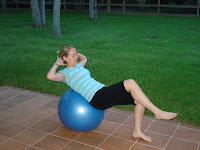
Stability ball crunch
Start sitting on the ball, and roll down slightly until the ball is supporting your lower back. Make sure to keep your ankles in line under your knees. Lift with the abs, up and down. If you feel too much strain, walk your feet out a little more so that the ball rolls a little higher into your mid-back.
Stability ball crunch with twist
If balance allows, try adding a little twist with each crunch
Stability ball crunch with march
First start by just holding the crunched position. While keeping your upper body still, slowly try and lift one leg and switch. Over time, try to hold your leg up a little higher or possibly add a little crunch to the mix.
Have fun and make smart choices! Pregnancy is not the time to kick your workout into high gear, but rather focus on staying healthy, comfortable, and maintaining your previous fitness level.
Have a HEALTHY day!
~ Fit Britt

Saturday, May 22, 2010

Are you doing ENOUGH?

Certainly the amount of physical activity we do is dependent on our fitness/health goals. The American College of Sports Medicine, which sets the guidelines that all other fitness organizations follow, has updated their guidelines for 2010. Here, I share them with you:

For Physical Activity and Health
The recommendation is now 30-60 minutes of moderate-intensity physical activity five times per week, or 20 minutes of vigorous-intensity physical activity three times per week.
Currently, more than 66% of adults are overweight and 32% are obese in the US.
For Cardiorespiratory Training
The intensity should be a combo of moderate (40 - 60% Heart Rate Reserve [HRR]) and vigorous (>60 - 85% HRR). However, if you are extremely deconditioned, start at an intensity of 30 - 40% HRR.
The duration should be at least 30 minutes for moderate intensity, sessions totaling 150 minutes a week. When using a more vigorous intensity, go for at least 20-25 minutes a session, totaling 75 minutes a week.
To promote or maintain weight loss, perform moderate exercise for 50-60 minutes per day with a total of 300 minutes a week.
For Muscular Strength/Endurance Training
2-4 sets are recommended for each muscle group (you can do the same exercise multiple times or do various exercises for that specific body part).
Strength training should be challenging, and you should work to the point of exhaustion with each set. Therefore, a 2-3 minute rest period is suggested between sets. (I still like to alternate body parts so I am working out another group instead of sitting on a bench for a 2 minute break between each exercise).
For older and/or deconditioned adults, start with only one set.
It is important to add in "neuromuscular training:" activities such as balance, agility, and proprioceptive training for at least 2-3 days per week. *this is great to work on your "functional fitness" and become more efficient at performing ADLs (activities of daily living).

For Flexibility Training
Static stretches should be held for 15-60 seconds.
For Special Populations
Pregnant Women: exercise at least 3, preferably all, days of the week. Use an intensity of 40 - 60% HRR, or a RPE (rate of perceived exertion) of 12-14 (on a scale from 6-20). Have our sessions last at least 15-30 minutes per day, for a total of 150 minutes a week.
Hypertensive Clients: There is concern with raising the blood pressure too high while doing vigorous exercise. Utilize an intensity of 40 - 60% HRR. Always remember to continue breathing (don't hold your breath) and limit going from lying to standing quickly (or vice versa) and minimize lifting weight over your head.

Have you ever considered logging your activity to calculate how much you perform in a week? I hope sharing these guidelines will encourage you to evaluate your program and make sure you are doing enough, whatever your goal may be!

Thanks to the May/June 2010 issue of American FITNESS, published by the Aerobic and Fitness Association of America for bringing the new guidelines to our attention, as well as to the American College of Sports Medicine for updating their guidelines and helping us stay on top of our game.

Have a HEALTHY day!
~Fit Britt

Tuesday, August 11, 2009

The Numbers that Drop the LBs.

Well? Have you done last week's assignment and found out how many calories you should be consuming each day? If you are looking to maintain your current weight, stick to that number and tweak it as needed (remember, because a calculation was used, this number is not 100% accurate). You can even add in a little more exercise (you should already be doing at least 30 minutes most days of the week) to give yourself a little more flexibility (ie: room for dessert) in your diet.

It truly does come down to the following scale:

If you want to lose weight, you will have to negate some calories by eating less and/or working out more. Let's break down some numbers:
- There are 3,500 calories in one pound of fat.
- Your goal should be to lose no more than 1-2 lbs a week (any more and you risk losing water and/or muscle weight instead, and it will most likely be more difficult to keep off).
- A healthy weight loss goal is to start with no more than 10% of your body weight (in the number of weeks it would take at 1-2 lbs a week).

So back to that pound of fat being 3,500 calories. That means to lose one pound a week, you would need a daily deficit of 500 calories (500 x 7 days a week = 3,500 calories). Likewise, to lose two pounds a week, that would be a 1,000 deficit each day (let's be honest, that's pretty challenging).

Remember that this deficit can (and should) come from a combination of taking some calories out of your diet and adding in more exercise. The good news is this can be flexible day by day (and this is how weight management becomes realistic to your lifestyle - no more yo-yo dieting!). Some days you just won't get an opportunity for a good calorie burning workout... on those days you'll have to eat less. On days you know you want to eat dessert or go out for drinks (more on the ridiculous number of empty calories in alcohol later), you'll need to plan extra workout time.

Please note: unless you are on a medically supervised weight loss plan, women should not go below 1200 calories a day, and men should not go lower than 1500 calories a day. As much as you might think "the lower I go the more weight I'll lose," the truth is your body has a limit where your thyroid and metabolism will significantly slow down when you starve yourself. Even with intense exercise, if your body is not getting an appropriate number of calories you will not lose weight (but will risk your health). Also remember that if you are breastfeeding or pregnant, you will need to a lot more calories for your body's and your baby's needs.

Up next: Carbs, Fat and Protein - The Good, the Bad, and the Misinformed. What percentages of each nutrient you should be consuming each day, the benefits of each nutrient and suggestions for healthy sources.

Have a HEALTHY day!
~ FitBritt

Thursday, August 6, 2009

Counting Calories

Have you ever tried counting your calories? What number are you aiming for by the end of the day? How did you come up with that number? Why does everyone think they need 2,000 calories? Read on for some tools that will help you figure out your individualized caloric intake!

Your caloric intake will depend mostly on your metabolism, but also on your daily activity level as well as your ultimate goal (gain, lose, maintain weight). Your metabolism is also very unique to you and is dependent upon many factors including:
Weight
Body Composition
Age
Gender
Genetics
Hormones
Drugs
Stress

Therefore, two females the same height and weight could have very different compositional make-ups, and therefore would have completely different metabolic rates!

Because it is so dependent on each of these factors, it’s best to actually have your metabolism tested in a fasted state to truly understand how your body works. This requires finding a place that offers testing with either a handheld device (such as the BodyGem which is less accurate but less expensive) or the full machine (metabolic cart) in which you lay in a “bubble” for twenty minutes and your oxygen and carbon dioxide exchange is analyzed. These tests give you your resting metabolic rate, or the number of calories that you burn each day just laying around and staying alive.
From this point, calculations can be done based on your activity level throughout the day, as well as your weight management goals to come up with a number of how many calories you should consume each day. Finally, you can make the caloric intake more flexible by adding exercise to burn off some of the additional calories that you consume (however don't make this the only reason you exercise - you'll be missing out on many great health benefits!).
This is the best approach to knowing exactly what your body needs and having specific numbers to help you reach your goals. Check with your gym or with a nutritionist to see if either of these tests are available. If you live near a university, it is very likely they have the equipment, it's just a matter of whether or not community members can pay or volunteer to take the tests.
So... how many calories can you safely subtract for weight loss and at what rate is weight loss most successful? You’ll have to stay tuned! In the meanwhile, I’m giving you an assignment to come up with a general idea about your caloric intake, since it is unlikely many of you will be able to have your metabolism tested.
Have you checked out the "new" food guide pyramid? Go to www.mypyramid.gov and spend as much time as you can clicking around this site. Your specific assignment:
1. Click on "I want to... Get a Personalized Plan" on the right side.
2. Fill out the needed information.
3. If it gives you the option of selecting a program for your current weight or for moving to a healthier weight... I, of course, suggest to move toward a healthier weight.
4. Keeping in mind that this does not take into consideration many individual factors, you now have a suggested nutrition program! Your suggested caloric intake should be written on the top line in bold. Below that is a breakdown of the proper proportions for each nutrient to add up to your calorie count.
5. If you scroll down you'll see a yellow bar for Fat and Discretionary calories. This gives you the number of calories in your plan that you can use for oils, condiments, salad dressings, dessert, etc.
6. Play around with it! Next to each colored tab you can click on "tips" to get suggestions for eating the healthier options for each category (wheat vs. white grains, etc.) Once you've clicked on tips you can also click on "What counts as one ounce" on the right side to get a better idea of the amount you should ingest daily.
7. You can also print a PDF of your plan to keep posted on your fridge, and also PDF checklists to see how close you come to meeting your plan each day.
8. If you are really excited about the record keeping, you can even click on MyPyramid Tracker to log your food and exercise. You can see many charts for how you are doing throughout the day that will help you know when you've eaten too much fat, not enough grains, etc.
**Alright all you moms out there... did you see that there is also a link for kids as well as for moms? There's even a pregnancy and breastfeeding link.

Check it out and let me know what you think! Next week we'll discuss altering your caloric intake and adding exercise in a safe and effective way to lose weight.

Monday, July 27, 2009

You Had Your Baby, Now What?!?

Howdy! Since I have around 10 new mommies following this blog, and this is by far the topic I have received the most inquiry about, I want to add to Environmental Mama's post and cover a few suggestions and dispel one myth regarding post-natal exercise and weight loss. After these specific suggestions, all my readers should be able to utilize my exercise suggestions in the following posts and gear them towards their current level of fitness.

As a general disclaimer, please remember that it is suggested to wait at least six weeks before you incorporate moderate or higher intensity physical activity (cardio or weight training) back into your lifestyle and you certainly need to make sure you are medically cleared.

Regarding the concern of breastfeeding: will exercise/diet limit your milk supply?
I have actually been researching this over the past few days, and I have not found a single study stating a concern over the supply of milk. What I have found over and over is that once your milk supply is well established, exercising should not affect the supply. It has been found, however, that some babies do not prefer the taste of milk shortly post-exercise due to increases in lactic acid in the milk. This can be minimized by feeding just prior to working out (allowing recovery time before the next feeding) and also by keeping your workouts to less than maximum effort. (If you find any depletion in supply or other adverse effects, try working out at a lighter intensity for a longer period of time - if time is an option).


Additional tips for minimizing the effects of exercise and diet on breast milk:
  1. Even though I know you want to focus on weight loss and on cutting calories, your primary concern needs to be on consuming the proper amount of nutrients for you and the baby. You should still be ingesting 200-500 more calories a day than you would if you were not nursing; at least 1800/day calories for the average mom.
  2. Try to eat more naturally made and organic foods. Refined and processed foods (white breads, sugary foods and non-perishables) deplete your body of many nutrients your body needs to process milk and provide for you and the baby.
  3. Drink lots of water ~ more than 64 oz. a day. If you are thirsty, you are dehydrated, don't let yourself get thirsty!
  4. Reduce stress to prevent additional hormones/chemicals in breast milk as well as an uneasy connection between you and the babe.
Other post pregnancy concerns:
It is probably easier to understand that your lifestyle needs to be modified during pregnancy when the baby is inside you. I can only imagine the desire and motivation to get back to your pre-baby weight ASAP. However, there is still a decent amount of recovery going on for up to six months. The list below will be taken into consideration with my exercise suggestions that follow.
  1. Relaxin stays elevated for months, the joints remain somewhat lax and are overall unstable.
  2. The abdominal wall and core musculature is stretched, weakened, and "out of practice."
  3. Due to the above two, the spine is more vulnerable to injury.
  4. There are postural distortions from pregnancy (tight hip flexors, abductors [outer thigh muscles], hip extensors [glutes], ankle plantar flexors [calves]) that need to be lengthened (stretched).
  5. Additionally, many moms do not focus on lifting, carrying and holding their babies in an "ergonomically correct" way. Therefore, these unbalanced movement patterns further distort posture which can actually limit your training and weight loss gains (many more posts on this in the future).
  6. Finally, those who have had a C-Section will need longer to recover and should not perform any abdominal exercises until completely healed.

Exercise Suggestions Specific to Post Preggers
So you might be a little low on energy and I'm pretty sure you are low on time. I think it'd be great if you could occasionally get some alone time so you can truly focus on yourself while working out, but there is also a lot of benefit to having the kid(s) with you (great bonding experience, setting a wonderful example).

Seems like whether you have kids or not, time is always a factor. I am very big into "multitasking fitness." I am also a fan of functional fitness ~ training for movements, not just training muscles. Over time I'll give you plenty of exercise ideas where you'll work multiple muscle groups all at once, helping to save you time and improve your functionality in life.

Alas here are the post pregnancy exercise suggestions:

  1. Correct muscular imbalances. Most commonly, as listed above you'll need to stretch your hip flexors (do lunging type activities and push your hips forward), outer thigh muscles (laying down cross one leg over the other in the shape of a "4," pull the support leg toward your body and gently push the stretching knee away from your body; then hug one knee into your chest and pull it across your body towards the opposite shoulder), and calves (lunge with your hands against the wall and press the back heel into the ground).
    Conversely, you'll need to focus on strengthening the opposite muscles to balance out. Try doing hip bridges (lay on your back with your heels near your hips, press your hips gently upward - squeeze your stomach and your glutes), inner thigh work (while on your back with knees up push your knees together and squeeze and hold while also bracing your stomach), and perform toe taps (in a seated position just tapping your toes) to strengthen the front of your shin and continue to stretch your calves.

  2. Your exercises should focus on core work. Sit ups and crunches will be too stressful for your abdominal muscles, first you need to focus on your transverse abdominis (this ab muscle wraps around your waist like a thick belt). Laying on your back, just focus on bracing your stomach, thinking about squeezing your stomach and thinning your waist from all angles. You can also practice doing this on all fours or while sitting or standing. Once you can hold for at least ten seconds WHILE BREATHING, start adding little movement. If you are on the floor, practice lifting one foot at a time, marching. If you are on your hands and knees, work on lifting one leg or arm of the ground then both (opposite arm and leg).

  3. You should also focus on stabilization exercises to improve joint stability. Using a stability ball or standing on one leg while performing various strength training exercises. This is my training style and many suggestions will be given in upcoming posts.

  4. Be conscious of how you are working with your baby. Hold/carry baby on both sides, use a sling to bring baby to you instead of having to bend forward to feed, get in front of baby and bend with your legs (or kneel) to pick up baby, lower crib rail so you don't have to reach away from body and lift with your back, think about posture when pushing a stroller (and swap your kids from side to side if you have a double stroller and two kids of differing weight).

Overall, it's going to be a process. Whether it's from having a baby, or just being overweight, the weight loss is not going to happen overnight. It will certainly be a journey and you'll learn a lot about yourself along the way. Maintain your sense of humor and have fun! Give yourself some credit for the amazing beings you have brought into your life. And most importantly, stay tuned - specific exercise ideas will be following in the upcoming weeks!

Feel free to leave additional suggestions in the comments, or email me with further questions!

Have a HEALTHY day!
~ Fit Britt

Followers